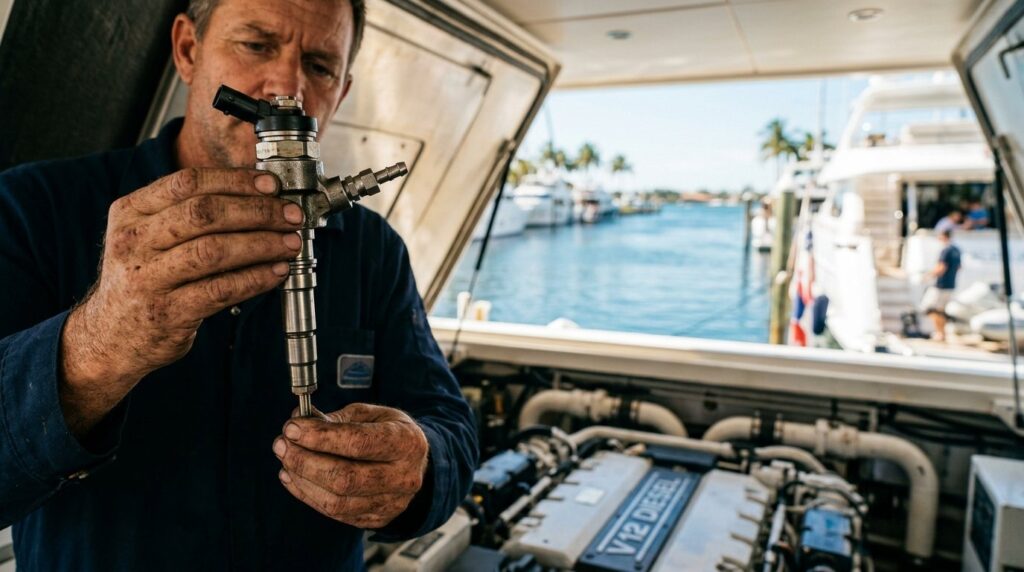
A single failing fuel injector can cost you more than you might expect — not just in repair bills, but in engine wear, reduced performance, and the kind of chronic fuel system damage that compounds quietly over time. For yacht owners in Palm Beach County and Broward County, understanding when marine diesel fuel injector replacement is necessary — and when it’s urgent — is one of the most valuable pieces of knowledge you can carry aboard.
Fuel injectors are the precision heart of any diesel engine’s combustion process. They atomize fuel into the combustion chamber at exact pressures, timing intervals, and spray patterns specified by the manufacturer. When that precision degrades, everything downstream suffers. Here’s what you need to know.
How Diesel Fuel Injectors Work
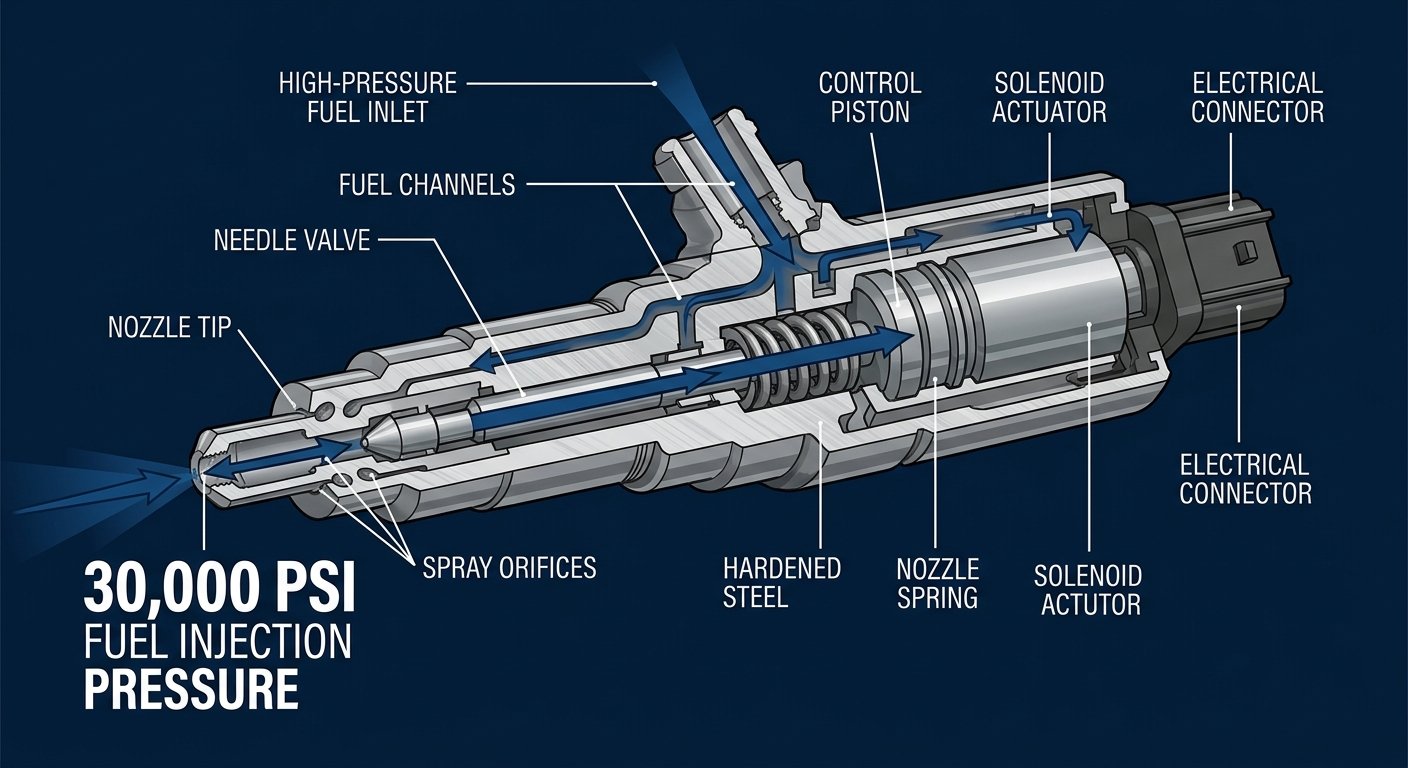
In a marine diesel engine — whether you’re running Detroit Diesel/MTU main propulsion or a Northern Lights, Kohler, or Westerbeke generator — fuel injectors operate under extraordinary pressure. Modern common-rail diesel systems deliver fuel at pressures exceeding 30,000 PSI. Even legacy mechanical injection systems operate at pressures that demand absolute precision in manufacturing tolerances.
Each injector’s job is to deliver a precisely metered fuel charge at exactly the right moment in the combustion cycle. When injectors wear, foul, or fail, that precision evaporates. The result is incomplete combustion, wasted fuel, elevated exhaust temperatures, and accelerated wear on pistons, rings, and cylinder liners — components that are far more expensive to address than the injectors themselves.
According to the Diesel Technology Forum, modern high-pressure fuel injection systems are engineered to extremely tight tolerances, making regular inspection and OEM-specification service essential to long-term reliability.
Warning Signs That Demand Attention
Boat fuel injector service becomes necessary when the injectors can no longer maintain manufacturer-specified performance. Recognizing the early signs is the difference between a planned service visit and an emergency at sea.
Hard Starting or Extended Cranking
If your diesel engine cranks longer than usual before firing — especially after the vessel has sat overnight or during a cold start — injector wear is a prime suspect. Worn injector nozzles can’t build adequate spray pressure, making ignition sluggish even when all other systems are functioning normally.
Rough Idle and Misfiring
A healthy diesel idles with a consistent, even rhythm. Rough idle, uneven firing, or noticeable vibration often indicate that one or more injectors are delivering inconsistent fuel charges. This imbalance forces other cylinders to compensate, accelerating wear across the engine.
Excessive Black or White Exhaust Smoke
Black smoke signals incomplete combustion from over-fueling — often caused by an injector stuck in the open position or a worn nozzle that floods the combustion chamber. White smoke at operating temperature can indicate an injector dribbling fuel after the injection event, causing unburned fuel to pass into the exhaust. Neither condition should be ignored.
Increased Fuel Consumption
When injectors lose their precision, engines consume more fuel to produce the same power output. If your vessel’s fuel burn has crept upward without changes to load or operating conditions, degraded injector performance is a serious possibility worth investigating. Yacht fuel system maintenance that includes injector service often pays for itself in fuel savings alone.
Loss of Power Under Load
Reduced top-end power, sluggish acceleration out of displacement, or an engine that struggles under normal load all point toward fuel delivery problems. When the combustion charge is inconsistent, the engine simply cannot produce its rated output.
Fuel in the Lube Oil
This is a critical finding. If your oil analysis shows fuel contamination — a service your factory-authorized technician can arrange — injector failure may have progressed to a point where fuel is bypassing into the crankcase. This requires immediate professional attention to prevent catastrophic engine damage.
Inspection Intervals and Service Life
Marine diesel fuel injection repair doesn’t always mean outright replacement. In many cases, injectors can be removed, tested on calibrated bench equipment, cleaned ultrasonically, fitted with OEM nozzle kits, and flow-tested back to factory specifications. Whether an injector is serviceable or must be replaced depends on the degree of wear found during professional diagnosis.
For most marine diesel engines operating in South Florida’s high-use boating environment, injector inspection is typically recommended every 1,000 to 2,000 hours of operation, or in accordance with the manufacturer’s maintenance schedule for your specific engine model. Detroit Diesel/MTU, for example, provides detailed service interval specifications in their published maintenance documentation that should be followed precisely.
The U.S. Environmental Protection Agency’s nonroad engine emissions standards also underscore why proper injector maintenance matters — poorly calibrated injectors that cause incomplete combustion directly contribute to elevated particulate emissions, a regulatory concern for commercial marine operators.
A properly maintained diesel engine — one that receives regular injector service, oil analysis, and fuel system attention — is genuinely capable of delivering 40 or more years of reliable service life. That’s not optimism; that’s what properly maintained marine diesels actually do. The injectors are a key variable in that longevity equation.
Why OEM Parts and Factory-Authorized Service Matter
When it comes to marine diesel fuel delivery problems, the quality of replacement components is not a place to compromise. Fuel injectors must meet the exact pressure, spray angle, and flow rate specifications set by the engine manufacturer. Aftermarket components that don’t match these specifications — even those that appear dimensionally similar — can introduce inconsistencies that affect combustion balance, warranty coverage, and long-term reliability.
As a factory-authorized marine diesel service provider, RPM Diesel sources OEM injector components through authorized manufacturer supply chains for Detroit Diesel/MTU, Northern Lights, Kohler, and Westerbeke equipment. This isn’t a procedural formality. It’s the difference between a repair that holds and one that creates new problems within a few hundred hours.
Proper diagnosis matters equally. Boat diesel fuel delivery problems can stem from multiple sources — contaminated fuel, failing high-pressure pumps, injector return line issues, or electronically controlled injector solenoids. Replacing injectors without identifying the root cause of the problem is an expensive way to temporarily mask a deeper issue. Factory-authorized diagnostic procedures, including pressure testing, fuel return flow measurement, and electronic control module interrogation where applicable, provide the complete picture before any parts are ordered.
Our marine diesel engine service approach integrates fuel system diagnosis as part of a comprehensive maintenance picture, not as an isolated procedure disconnected from overall engine health.
Fuel Quality and Injector Longevity
In South Florida’s marina environment, fuel quality deserves specific attention. Diesel fuel that has been stored in dock tanks for extended periods can accumulate microbial growth, water contamination, and fuel degradation byproducts that accelerate injector fouling and wear. Fuel polishing and regular tank inspection are proactive steps that extend injector service life and prevent emergency situations on the water.
If you’re fueling from the same marina consistently and noticing accelerating injector wear, a fuel sample analysis is a worthwhile investment. Your RPM Diesel technician can advise on appropriate fuel treatment and filtration upgrades that protect your injection system between service intervals.
For vessels requiring service at their slip or dock, our on-site diesel marine engine service capabilities bring factory-authorized expertise directly to you throughout Palm Beach County and Broward County.
Frequently Asked Questions
How do I know if my marine diesel fuel injectors need replacement versus cleaning?
Bench testing is the only reliable way to determine this. A qualified technician will remove the injectors, test opening pressure, spray pattern, and flow rate against manufacturer specifications, then ultrasonically clean them and retest. Injectors that cannot be returned to spec through cleaning and nozzle kit replacement require full replacement.
Can a single bad injector damage other engine components?
Yes, significantly. A misfiring or over-fueling injector creates combustion imbalance that increases thermal stress on pistons and cylinder liners in affected and adjacent cylinders. Over time, this contributes to accelerated ring wear, blow-by, and loss of compression — damage that far exceeds the cost of timely injector service.
How long does marine fuel injector replacement typically take?
Service time varies depending on the engine configuration, number of cylinders, and degree of access. Your technician will provide a specific assessment after inspection. What matters most is that the work is performed correctly to manufacturer specification, not rushed.
Does injector service affect my engine warranty?
Using a factory-authorized service provider and OEM parts preserves your manufacturer warranty coverage. Work performed outside factory-authorized procedures — or with non-OEM components — can create warranty compliance issues with manufacturers like Detroit Diesel/MTU.
How often should injectors be inspected on a generator set?
Generator sets from Northern Lights, Kohler, and Westerbeke each publish specific maintenance intervals for injector inspection in their operator documentation. For most recreational and commercial applications, inspection every 1,000 hours or annually — whichever comes first — is a reasonable baseline, subject to the manufacturer’s published schedule for your specific unit.
Schedule a Professional Injector Evaluation
If your vessel is showing any of the warning signs described here — rough idle, black smoke, increased fuel consumption, hard starting, or power loss — don’t wait for the problem to escalate. Fuel injector issues that are caught early are service items. Left unaddressed, they become engine repair situations.
RPM Diesel provides factory-authorized marine diesel fuel injection repair for yacht and boat owners throughout Palm Beach County and Broward County. Our technicians work to manufacturer specifications with OEM components, delivering the kind of marine diesel engine repair that protects your investment for the long term.
Contact RPM Diesel to schedule a fuel system inspection and get your vessel operating at the precision your engine was built to deliver.