
When your MTU marine diesel suddenly struggles to reach cruising speed or labors under load, the causes can range from straightforward fuel delivery issues to complex turbocharger malfunctions. Understanding what triggers MTU engine power loss helps vessel owners recognize problems early, prevent catastrophic failures, and avoid costly downtime during critical voyages.
MTU engines represent some of the most sophisticated marine propulsion systems on the water today. Their advanced electronic controls, high-pressure fuel injection, and precision turbocharging deliver exceptional performance—but only when every component functions within manufacturer specifications. When power drops, systematic diagnostics by factory-authorized technicians become essential to identifying root causes rather than merely treating symptoms.
1. Fuel System Contamination and Restrictions
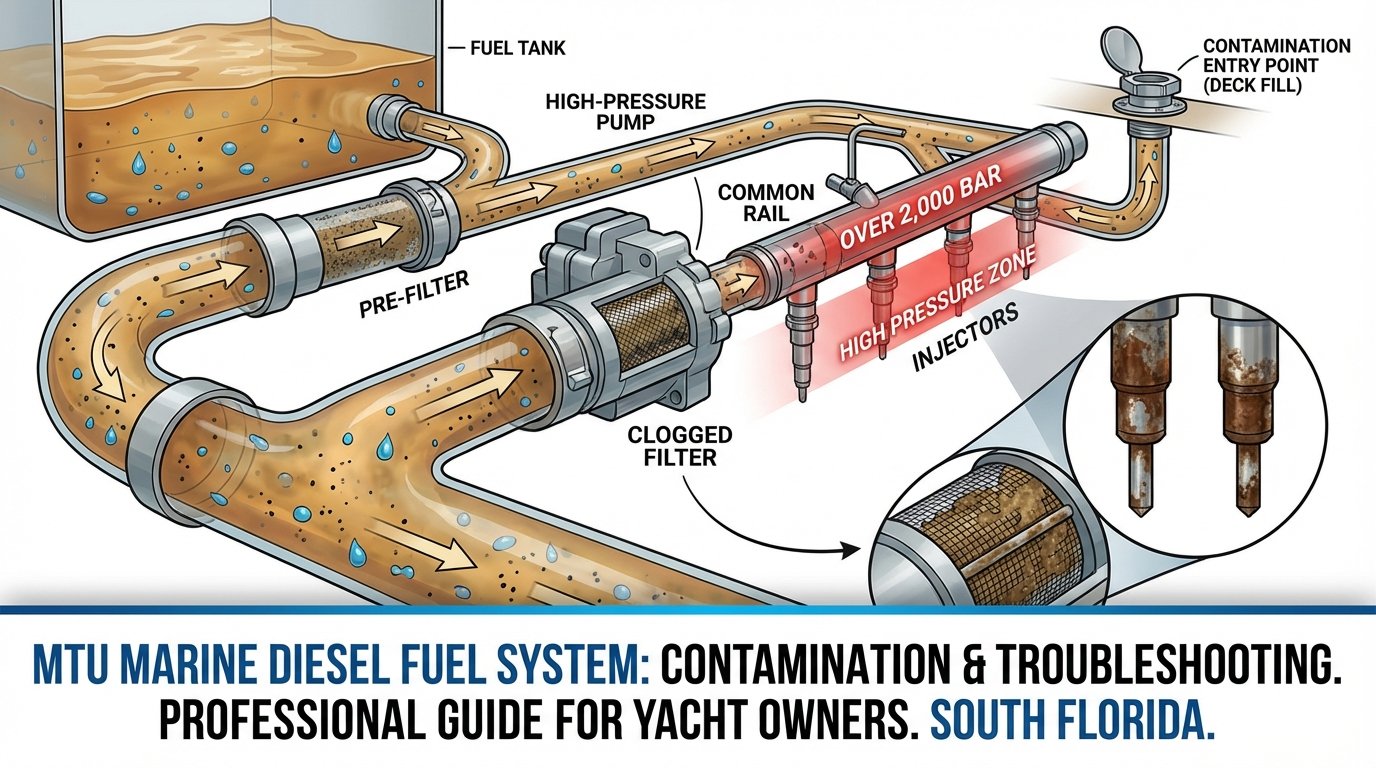
The MTU fuel system operates under extreme pressures, with common rail systems exceeding 2,000 bar in modern engines. Even microscopic contamination can create significant MTU marine diesel problems. Water infiltration ranks as the most frequent culprit, entering through poorly sealed deck fills, condensation in tanks, or contaminated fuel supplies at marinas.
Water in diesel fuel causes immediate performance degradation. MTU’s high-precision injectors require fuel cleanliness to ISO 4406 standards of 16/14/11 or better. When water passes through the fuel system, it damages injector nozzles, causes corrosion in fuel pumps, and supports microbial growth that clogs filters. Vessel owners often notice power loss that worsens gradually as filters become increasingly restricted.
Biological growth in fuel tanks—commonly called diesel algae—creates sludge that blocks fuel pickup screens and overloads filters. This contamination thrives in the water-diesel interface and multiplies rapidly in warm climates. Professional fuel polishing and tank cleaning restore system integrity, but prevention through proper biocide treatment proves more cost-effective than reactive repairs.
Clogged fuel filters represent the final barrier before contamination reaches injectors. MTU specifies filter change intervals based on operating hours, but contaminated fuel requires more frequent replacement. Progressive filter restriction triggers warning alarms before complete blockage occurs. Ignoring these warnings leads to fuel starvation under load when engine demand exceeds available flow through restricted filters.
2. Turbocharger Failures and Degradation
MTU turbocharger issues directly impact engine power because these engines rely on forced induction to achieve their impressive power density. When turbochargers underperform, engines cannot generate specified boost pressure, resulting in incomplete combustion, reduced power output, and increased exhaust temperatures.
Turbocharger failures typically stem from lubrication problems. MTU turbos spin at speeds exceeding 100,000 RPM, requiring clean oil at proper pressure and temperature. Oil contamination, delayed oil changes, or insufficient warm-up and cool-down procedures destroy turbocharger bearings. Vessel owners who immediately load engines heavily after starting or shut down without appropriate cool-down periods experience premature turbocharger failure.
Compressor fouling gradually reduces turbocharger efficiency without complete failure. Salt air, oil vapor, and combustion deposits coat compressor wheels, disrupting aerodynamics and reducing boost capability. This degradation occurs slowly, making it difficult to recognize until power loss becomes significant. Regular turbocharger inspections by factory-authorized technicians identify fouling before performance suffers dramatically.
Exhaust side failures include cracked turbine housings, eroded turbine wheels, and stuck variable geometry mechanisms in VGT-equipped engines. These problems create excessive exhaust backpressure that restricts engine breathing, limits power output, and increases cylinder temperatures. Marine diesel diagnostics with pressure testing pinpoint exhaust restrictions that visual inspection might miss.
3. Air Intake System Restrictions
Turbocharged MTU engines consume massive air volumes—a restriction anywhere in the intake path immediately limits power. Clogged air filters represent the most common restriction, particularly on vessels operating in dusty environments or those with engine rooms exposed to salt spray.
MTU specifies maximum allowable intake restriction, typically around 25 inches of water column. Exceeding this threshold forces the turbocharger to work harder generating required boost pressure, increasing turbine drive pressure and exhaust temperatures. The additional workload reduces turbocharger life while robbing power from the propeller shaft.
Intercooler fouling restricts airflow while reducing cooling efficiency. These heat exchangers remove heat from compressed intake air, increasing air density and allowing greater fuel injection for more power. When intercooler passages clog with debris or develop internal scale from cooling system neglect, both airflow and cooling capacity suffer. The resulting hot, restricted charge air significantly reduces engine power output.
Collapsed intake ducting or damaged charge air piping creates restrictions that standard pressure testing reveals. Flexible intake connections deteriorate from heat, oil exposure, and vibration, sometimes collapsing internally while appearing intact externally. Factory-authorized service includes thorough intake system inspection using specialized diagnostic equipment that identifies these hidden restrictions.
4. Exhaust System Backpressure
Excessive exhaust backpressure forces MTU engines to work against themselves, using power to expel combustion gases rather than turning propellers. MTU specifies maximum backpressure limits—exceeding these parameters reduces power, increases temperatures, and accelerates component wear.
Carbon buildup in exhaust risers, mufflers, and piping gradually increases backpressure over thousands of operating hours. This accumulation occurs faster with improper fuel quality, incorrect injector timing, or engines operated predominantly at light loads. The progressive restriction creates power loss so gradual that operators adapt without recognizing degradation until acceleration becomes noticeably sluggish.
Collapsed exhaust components create sudden power loss. Marine exhaust systems endure constant thermal cycling, corrosive exhaust gases, and cooling water injection. Internal baffles in mufflers can separate and block flow. Water-cooled exhaust elbows corrode through from the inside, with corrosion products partially blocking passages. Systematic backpressure testing during scheduled maintenance identifies developing restrictions before complete blockage occurs.
5. Electronic Control System Faults
Modern MTU engines rely on sophisticated electronic controls managing fuel injection, turbocharger geometry, and emissions systems. Electronic faults can limit power through programmed de-rate strategies that protect engines from damage when sensors detect abnormal operating conditions.
The MTU engine control unit monitors dozens of parameters continuously, comparing actual values against programmed specifications. When exhaust temperatures exceed limits, boost pressure falls below targets, or coolant temperatures rise dangerously, the ECU reduces fuel delivery to prevent catastrophic damage. Vessel owners experience sudden power loss with active fault codes, but the de-rate protects expensive engine components from failure.
Sensor failures create false readings that trigger unnecessary de-rates. Failed boost pressure sensors may indicate low boost when actual pressure remains adequate. Malfunctioning temperature sensors report overheating that doesn’t exist. These phantom faults require proper marine diesel diagnostics using MTU-specific diagnostic software and equipment. Generic diagnostic tools cannot access proprietary MTU systems or properly interpret fault codes.
Wiring harness deterioration causes intermittent faults that prove difficult to diagnose without systematic testing. Marine environments attack electrical connections through corrosion, vibration loosens terminals, and engine heat degrades insulation. Intermittent connections create erratic sensor signals that confuse control systems, resulting in inconsistent power delivery and unpredictable performance.
6. Injector Problems and Fuel Delivery Issues
MTU common rail injectors precisely meter fuel at extreme pressures, atomizing diesel into microscopic droplets for complete combustion. When injectors malfunction, individual cylinders lose power, creating overall engine performance degradation proportional to the number of affected cylinders.
Injector wear develops gradually from normal operation but accelerates dramatically with contaminated fuel. Precision machined to tolerances measured in microns, injector nozzles erode from abrasive particles in fuel. This erosion changes spray patterns, reduces atomization quality, and allows fuel dribbling that washes cylinder walls and contaminates engine oil. The resulting incomplete combustion reduces power while increasing fuel consumption and exhaust smoke.
Stuck injectors either fail open or closed. Injectors stuck open dump excessive fuel into cylinders, creating rough operation, black smoke, and potential cylinder washing that damages rings and bearings. Closed injectors prevent fuel delivery to affected cylinders, causing power loss, rough running, and elevated exhaust temperatures as remaining cylinders compensate for dead cylinders.
High-pressure fuel pump wear reduces rail pressure below specifications, limiting the fuel quantity injectors can deliver regardless of injector condition. MTU engines require specific rail pressures to achieve rated power—insufficient pressure means insufficient fuel for maximum output. Factory-authorized technicians use MTU diagnostic software to monitor actual versus commanded rail pressure, identifying pump degradation before complete failure.
7. Mechanical Wear and Internal Component Failures
Despite MTU’s reputation for longevity, mechanical wear eventually affects even properly maintained engines. Worn piston rings reduce compression, allowing combustion gases to blow past pistons rather than pushing them downward. This compression loss directly translates to power loss, particularly noticeable during acceleration and heavy loading.
Cylinder head gasket failures allow compression leakage between cylinders or into cooling passages. These failures create multiple problems simultaneously: lost compression reduces power, coolant contamination damages bearings, and combustion gases pressurize cooling systems. Head gasket failures require immediate attention—continued operation risks catastrophic engine damage costing hundreds of thousands in repairs.
Valve train wear affects breathing efficiency. Worn camshaft lobes, degraded valve springs, or improperly adjusted valve clearances prevent valves from opening fully or closing completely. Restricted valve opening limits airflow into and out of cylinders, reducing the engine’s ability to breathe and generate power. Valve clearance adjustments represent critical maintenance that prevents performance degradation and costly repairs.
Bearing wear increases internal friction while allowing excessive crankshaft movement that disrupts injection timing and valve timing. Worn main bearings and rod bearings rob power by converting fuel energy into heat through friction rather than useful work. Advanced bearing wear creates knocking sounds and metal contamination in engine oil—clear signs requiring immediate professional inspection.
Proper Diagnosis Prevents Expensive Mistakes
Correctly identifying MTU engine power loss causes requires sophisticated diagnostic equipment, factory-specific software, and deep understanding of MTU systems. Guessing at solutions wastes money replacing components that aren’t actually defective while leaving real problems unaddressed.
Factory-authorized MTU service centers access technical support, service bulletins, and engineering expertise unavailable to general repair shops. They use genuine MTU diagnostic tools that communicate directly with engine control systems, retrieving detailed fault histories and real-time operating parameters. This information guides systematic troubleshooting that identifies root causes rather than symptoms.
Comprehensive power loss diagnostics include cylinder compression testing, fuel system pressure testing, boost pressure verification, exhaust backpressure measurement, and electronic system analysis. Each test eliminates possibilities, narrowing the diagnosis until the actual problem becomes clear. Attempting repairs without proper diagnosis often makes problems worse, particularly when incorrect parts get installed or adjustments get made based on assumptions rather than measurements.
Partner With Factory-Authorized MTU Experts
MTU engine power loss rarely resolves itself—problems typically worsen until catastrophic failures occur. Early professional diagnosis and repair using genuine MTU parts preserves engine value, prevents secondary damage, and restores performance to factory specifications.
RPM Diesel Engine Company brings 68 years of marine diesel expertise to every diagnostic challenge. Our factory-authorized technicians specialize in MTU engines, maintaining relationships with MTU engineering and accessing the latest technical information. Our 68,000+ part inventory ensures genuine MTU components remain available when repairs require parts replacement.
We provide worldwide service capabilities for vessels requiring assistance anywhere their travels take them. Whether conducting scheduled maintenance, responding to unexpected power loss, or performing comprehensive engine surveys, our team delivers the expertise MTU owners expect.
Contact RPM Diesel Engine Company today for factory-authorized MTU diagnostics and service. Protect your investment with proper maintenance from technicians who understand these sophisticated engines completely. Your MTU engine represents substantial investment—trust its care to specialists with the knowledge, equipment, and parts inventory to maintain peak performance for decades of reliable service.