
Why Your DD15 Engine Family Number Matters
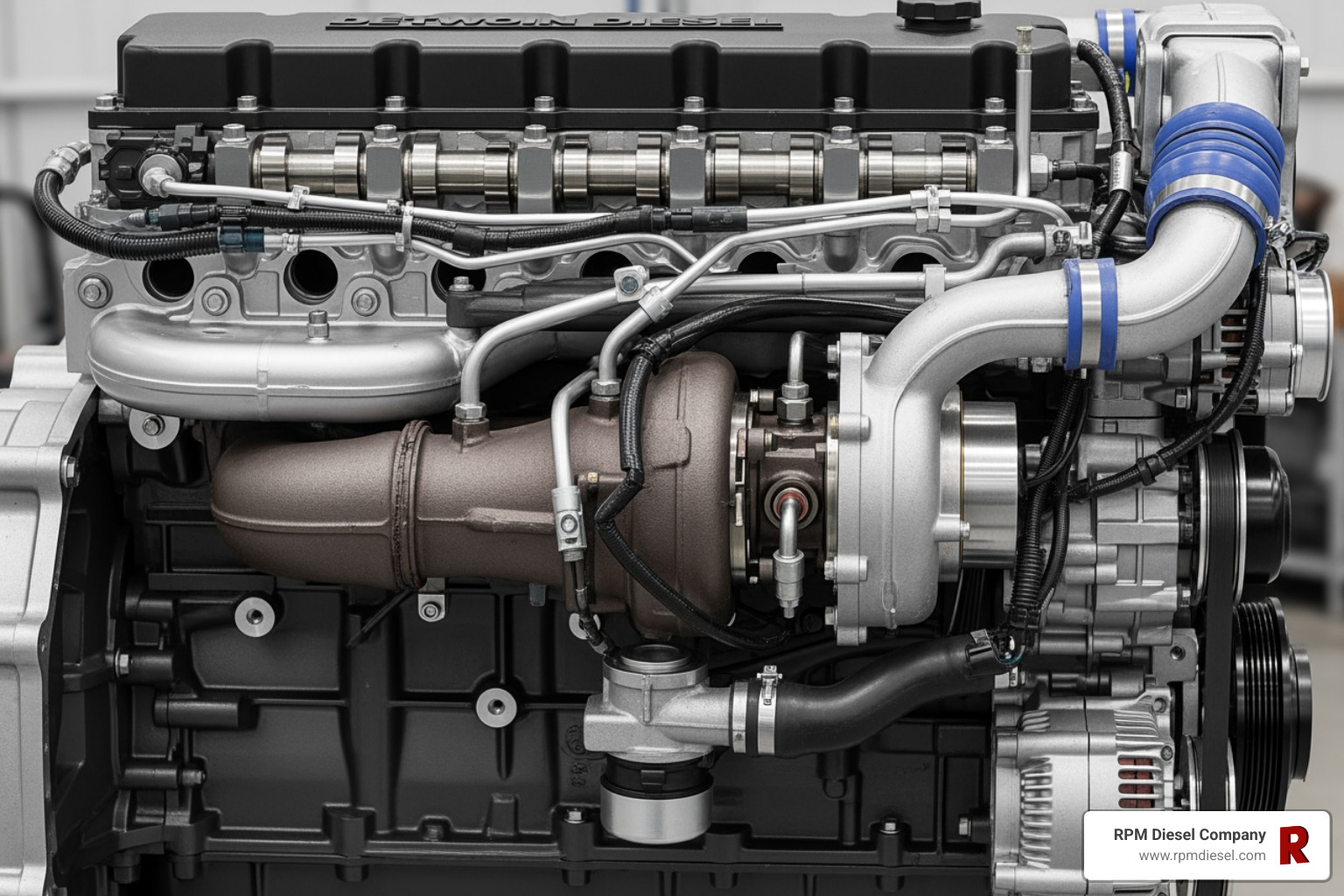
The dd15 engine family number is a specific alphanumeric code printed on your engine’s certification label that identifies which emissions standard family your engine belongs to. Here’s how to find it:
Quick Answer: Locating Your DD15 Engine Family Number
- Look at the valve cover (rocker cover) – Find the Engine Certification Label sticker
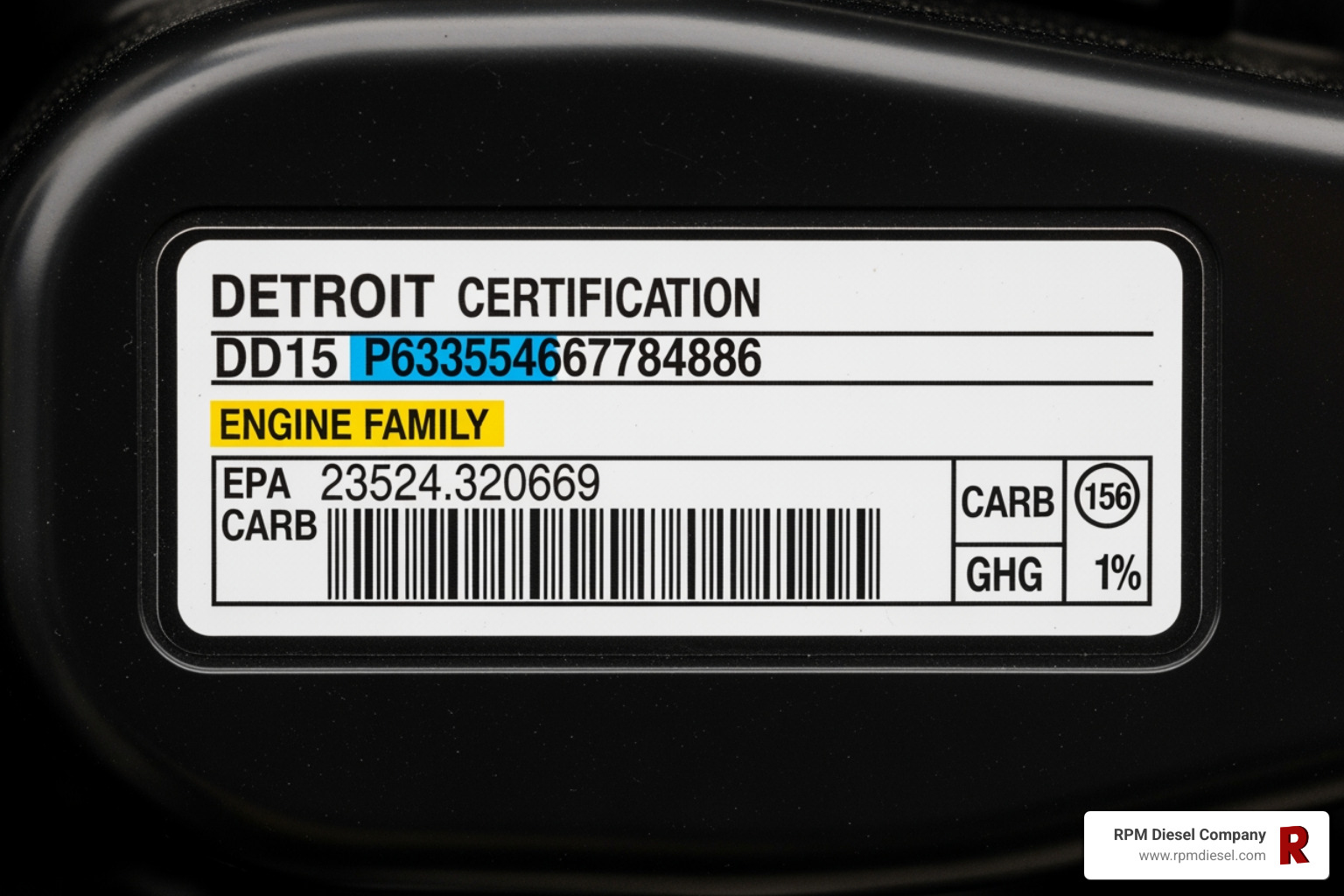
- Locate the “Engine Family” line – It will show a code like “GDDXH14.8EAD” or “EDDXH14.8EAD”
- If the label is missing – Use your 14-digit Engine Serial Number (ESN) and contact an authorized dealer to look it up
The Detroit DD15 is a workhorse marine diesel engine, but when you need service, parts, or emissions documentation, knowing just the model name isn’t enough. The engine family number is your key to accurate parts ordering, regulatory compliance, and proper service records.
This number tells you exactly which emissions certification group your engine belongs to – whether it’s EPA10, GHG14, GHG17, or another standard. Without it, you risk ordering wrong parts, failing inspections, or getting mismatched components that could damage your engine.
As one frustrated boat owner found on an online forum, after visiting multiple dealerships and even the Detroit Diesel corporate office, he still couldn’t get his engine family number because “dealerships don’t know how to get this done.” The number was there all along—on a small plate on the valve cover that was just hard to see.
This guide will show you exactly where to find this critical number on your DD15 marine diesel engine, what it means, and what to do if the label is missing or damaged.
What is the DD15 Engine Family Number and Why is it Critical?
Think of your dd15 engine family number as your engine’s genetic code. It’s not just a random collection of letters and numbers slapped on a labelit’s a precise identifier that tells the story of your engine’s design, emissions controls, and regulatory compliance.
This alphanumeric code groups your DD15 with other engines that share the same basic DNA: similar displacement, design characteristics, and most importantly, the same emissions control systems. When Detroit Diesel builds engines, they don’t just make one-off units. They create families of engines that are certified together to meet specific environmental standards.
For marine diesel engines like yours, this matters more than you might think. The dd15 engine family number is your proof that your engine meets the strict requirements set by the U.S. Environmental Protection Agency (EPA) and other regulatory bodies, including state programs such as CARB’s Engine Certification. Whether it’s EPA10, GHG14, or GHG17 standards, this number confirms your engine is legal to operate in U.S. waters.
And here’s the practical reality: without this number, getting the right parts or accurate service becomes a guessing game. Nobody wants to play guessing games with a marine diesel engine that costs as much as a luxury car.
The Role in Emissions and Certification
The engine family number comes directly from Detroit Diesel and gets certified by the EPA through a rigorous testing process. This certification isn’t just paperworkit’s a legal guarantee that every engine in that family consistently meets specific emission limits for pollutants like nitrogen oxides and particulate matter.
Here’s where it gets interesting: not all DD15 engines are created equal from an emissions standpoint. An engine certified under EPA10 standards uses different emissions control technology than one certified under GHG17. The aftertreatment systems, calibration software, and even some physical components vary based on which emissions standard the engine was built to meet.
That certification label on your engine’s valve cover? It’s actually a legal document. It proves your engine conforms to federal and state emissions regulations for marine applications. During inspectionsespecially in environmentally sensitive areasthis label is your ticket to continued operation.
We’ve seen boat owners struggle with inspections simply because they couldn’t locate or read their engine family number. In some cases, that’s led to operational delays or restrictions until compliance could be verified. It’s a small piece of information with big consequences.
Why It’s Essential for Service and Parts
Let’s talk about what happens when you need parts or service for your DD15. This is where the dd15 engine family number becomes your best friendor where its absence becomes a serious headache.
Modern marine diesel engines are incredibly sophisticated machines. Even within the DD15 lineup, there are significant variations. The fuel injectors, turbochargers, and aftertreatment components can differ based on the emissions family. A DD15 from 2010 doesn’t use the same aftertreatment system as a DD15 from 2017, even though they’re both DD15 engines.
When you call us at RPM Diesel for parts, we need that engine family number to pull the exact right component for your specific engine configuration. Without it, we’re working blind. We can make educated guesses based on the engine serial number and model year, but guessing isn’t what you want when it comes to marine diesel engines that power your vessel.
Using the wrong parts creates a domino effect of problems. Incorrect parts might not fit properly, wasting your time and money on returns and reorders. Even if they physically fit, incompatible components can reduce your engine’s performanceless power, higher fuel consumption, mysterious warning lights on your dash.
Worse yet, wrong parts can compromise your emissions system, leading to failed inspections and potential fines. In the absolute worst case, mismatched components can cause serious engine damage. We’ve seen turbochargers fail, injectors malfunction, and aftertreatment systems clogall because someone installed a part that wasn’t quite right for that specific engine family.
There’s also the warranty consideration. Installing non-specified parts can void your engine warranty, leaving you on the hook for expensive repairs that should have been covered.
At RPM Diesel, our factory-authorized status with Detroit Diesel gives us access to the detailed specifications for every engine family. When you provide us with your dd15 engine family number, we can guarantee you’re getting the exact component your engine needs. No guesswork, no crossed fingers, no expensive mistakes.
That’s the difference between generic service and specialized marine diesel expertise. We know these engines inside and out, and we know that precision matters when you’re miles offshore relying on that DD15 to get you home safely.
How to Find the Number on Your DD15 Engine
Now that you understand why the dd15 engine family number matters, let’s get practical. Finding this number on your marine diesel engine is usually pretty straightforwardas long as you know where to look and the labels haven’t been subjected to too much saltwater spray over the years. We’ll walk you through the exact steps to locate both your engine family number and your engine serial number, which you’ll want to keep handy for any future service needs.
Step 1: Locate the Engine Certification Label
The fastest route to your dd15 engine family number is through the engine certification label. This small but mighty piece of documentation is permanently attached to your engine and contains all the regulatory information you need.
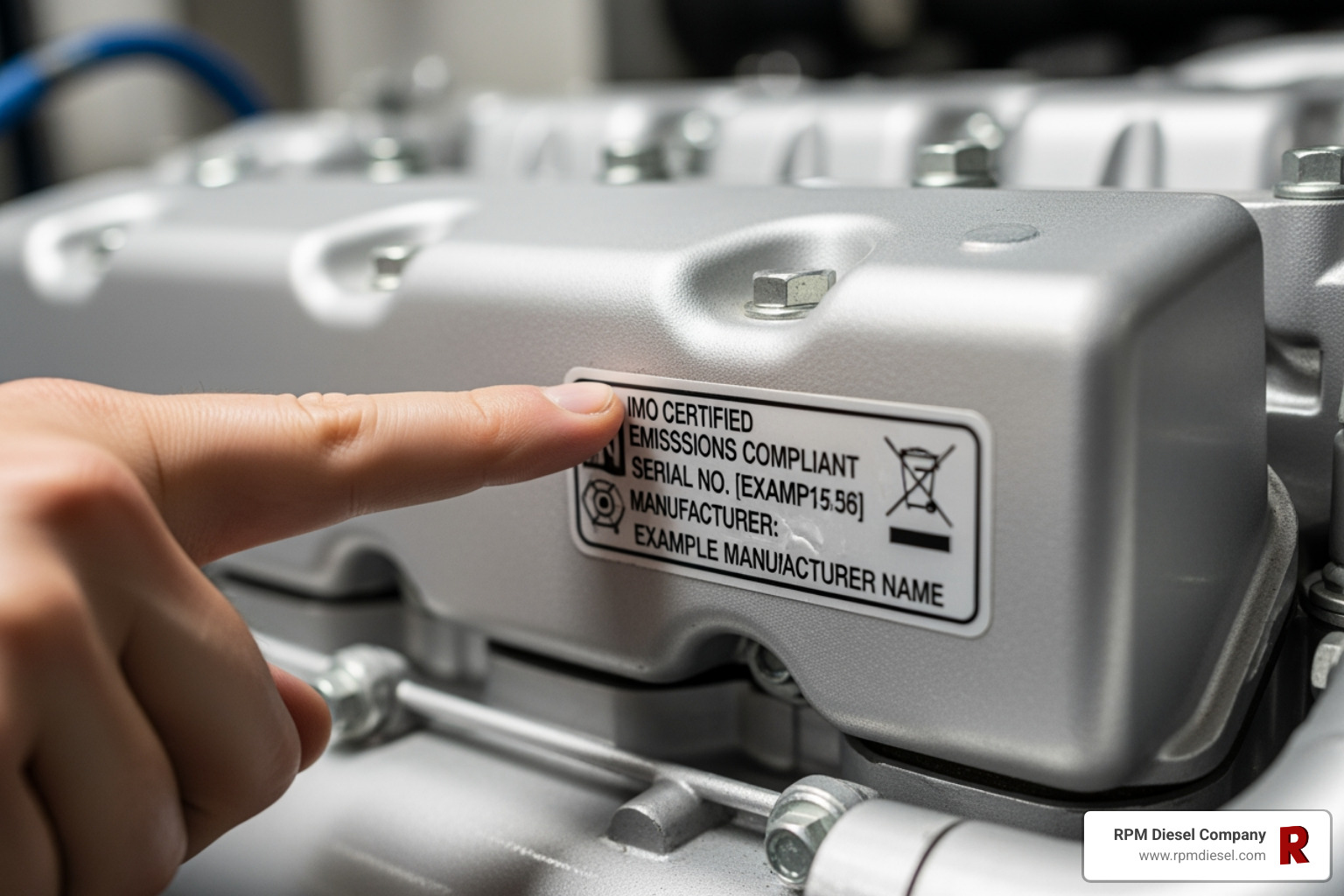
Start with the rocker cover. This label lives on top of your engine, specifically on the rocker cover (you might also hear it called the valve cover). It’s that large cover protecting all the valve train components underneath. On most DD15 marine engines, you’ll find the label right there where it’s relatively easy to spotthough “easy” can be relative when you’re working in a cramped engine room.
The label itself might be a metallic sticker or a small riveted plate, depending on when your engine was manufactured. It’s packed with information: engine model, displacement, horsepower ratings, and various emissions certifications from the EPA, CARB, and other regulatory bodies. Right there among all those details, you’ll see a line that says “Engine Family” or “Engine Family Number.” The actual code will look something like “GDDXH14.8EAD” or “EDDXH14.8EAD”a seemingly cryptic string of letters and numbers that we’ll help you decode in the next section.
Here’s the reality check: marine environments aren’t kind to stickers. Between salt spray, engine heat, humidity, and the occasional overzealous cleaning, these labels can fade, peel, or get covered in grime. If you’re having trouble reading yours, grab a flashlight and gently clean the area with a soft cloth. Sometimes a little patience and the right angle of light makes all the difference. Just take your timethis number is worth finding.
Step 2: Find the Engine Serial Number
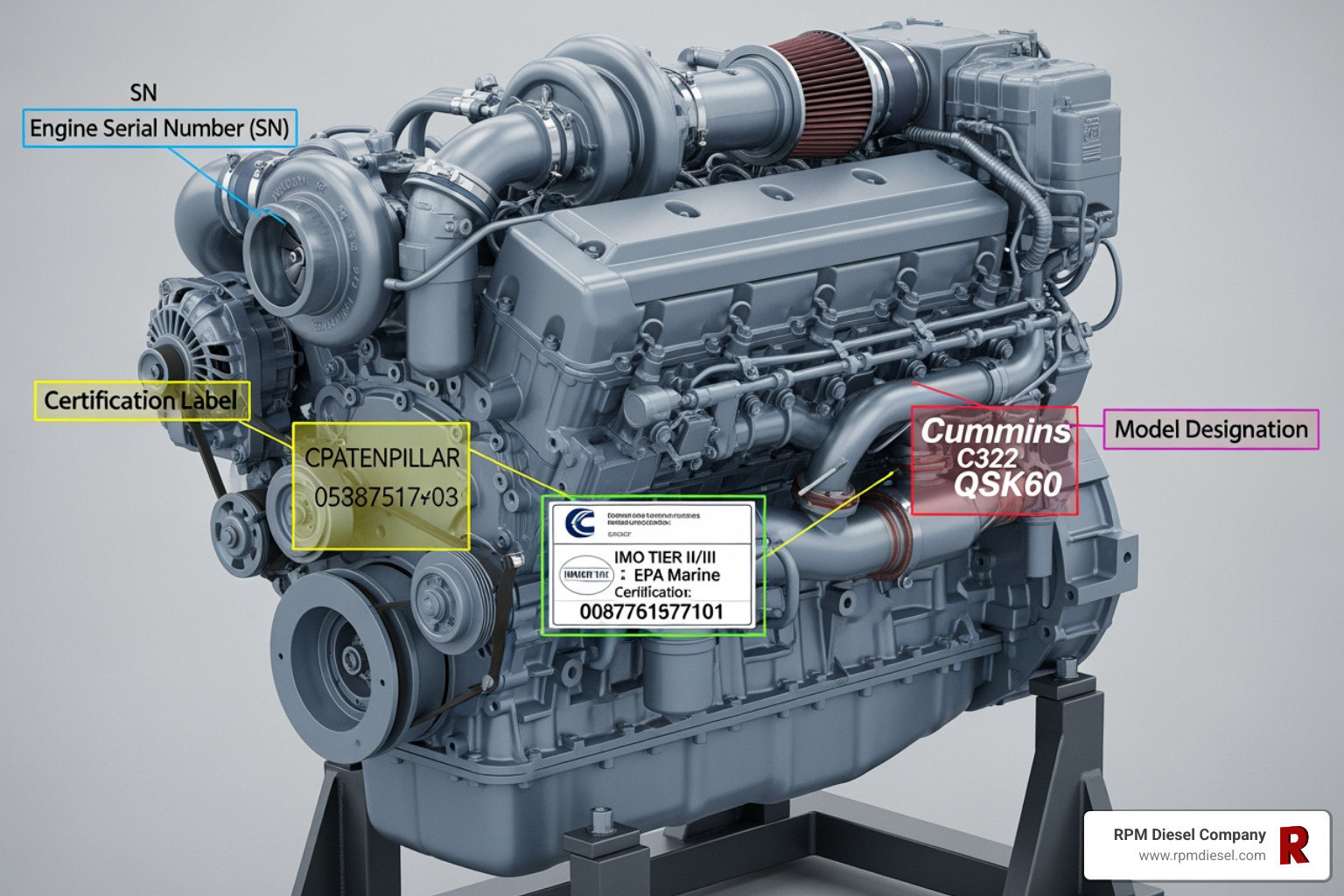
While you’re already poking around your engine, this is the perfect time to locate your Engine Serial Number (ESN) as well. This 14-digit code is just as important as the engine family numberin fact, if your certification label is missing or damaged, the ESN becomes your backup key to finding everything else you need.
Look at the cylinder block. Unlike the certification label sticker, the Engine Serial Number is permanently etched directly into the metal of your engine’s cylinder block. You’ll find this stamped pad on the left-front side of the engine, typically positioned above where the date and time of manufacture are marked. It’s not going anywherethis number is literally carved in stone (well, cast iron).
The ESN is a fourteen-digit alphanumeric code that’s completely unique to your specific engine. Think of it like your engine’s fingerprint. No two DD15 engines share the same ESN. A typical example might look like “472901S0005703.” This number tells the whole story of your engine: what model it is, what application it was built for, which assembly plant put it together, and its unique sequential serial number.
Prefer a quick visual? Watch this short video: How to Find Your Detroit DD15 Engine Serial Number.
Write both numbers down. Seriously, grab your phone and snap a photo of each one, or better yet, record them in your vessel’s maintenance logbook. Having your dd15 engine family number and your Engine Serial Number readily available will save you time and headaches whenever you need to call us for parts or service. There’s nothing more frustrating than needing a critical part and having to climb back into the engine room to read off numbers while you’re on the phone.
Decoding Detroit DD15 Engine Numbers
Once you’ve located your engine’s identification numbers, you might be wondering what all those letters and digits actually mean. Think of these codes as your engine’s unique fingerprint and family tree combined. They tell a detailed story about where your marine diesel engine came from, what standards it meets, and how it was built. Let’s decode these numbers together so you can truly understand what makes your DD15 tick.
Decoding the DD15 Engine Family Number
The dd15 engine family number isn’t just a random jumble of characters slapped on a label. It’s actually a carefully structured code that packs a lot of information into a compact format. Each segment of this alphanumeric string tells us something specific about your engine’s emissions certification and design characteristics.
Let’s break down a real-world example. Say your engine certification label shows GDDXH14.8EAD, which you might find on a 2016 DD15 EPA17 engine. Or perhaps you see EDDXH14.8EAD, which was reported by a boat owner with a 2012 DD15. Here’s what each part of that code is telling us:
The first character (like ‘G’ or ‘E’) represents the model year code for when this engine family was certified. A ‘G’ typically indicates a newer certification year, often 2016 or later, while an ‘E’ points to an earlier year like 2012. This single letter helps us immediately identify which emissions standard your engine meetswhether that’s EPA10, GHG14, GHG17, or another certification.
The next three characters (usually ‘DDX’) are the manufacturer code. For your Detroit Diesel engine, you’ll consistently see this DDX designation, which is essentially Detroit’s signature on the certification.
Following that, you’ll see a single character (often ‘H’) that designates the engine type or duty cycle. The ‘H’ typically stands for Heavy-Duty, which makes sense for the robust DD15 powering your marine vessel.
The next digits (14.8) are wonderfully straightforwardthey tell you the engine displacement in liters. For the DD15, this is always 14.8 liters, which is one of the engine’s core specifications and a big part of what gives it such impressive power for marine applications.
Finally, those remaining characters (like ‘EAD’) provide the specific engine family and configuration code. This is where things get really detailed. These letters and numbers encode information about the engine’s particular emissions control strategy, specific hardware configurations (such as asymmetric turbo or turbo compound systems), and other unique characteristics that differentiate your engine from other DD15 variants. It’s in this final segment where the nuances between different emissions standards really show up.
When we at RPM Diesel see your dd15 engine family number, we can instantly understand your engine’s emissions profile and key design features. This knowledge is absolutely essential when we’re ordering parts or planning service work, ensuring everything we do is perfectly matched to your specific engine configuration.
Understanding the 14-Digit Engine Serial Number
While the engine family number groups your DD15 with similar engines for emissions purposes, the 14-digit Engine Serial Number (ESN) is all about your individual engine. Think of it like the difference between your family name and your full nameone identifies the group you belong to, while the other identifies you specifically.
This ESN is permanently etched onto your engine block, making it a lasting identifier that stays with the engine throughout its entire life. It contains a wealth of information about your engine’s manufacturing origins, its original intended application, and its place in the production sequence.
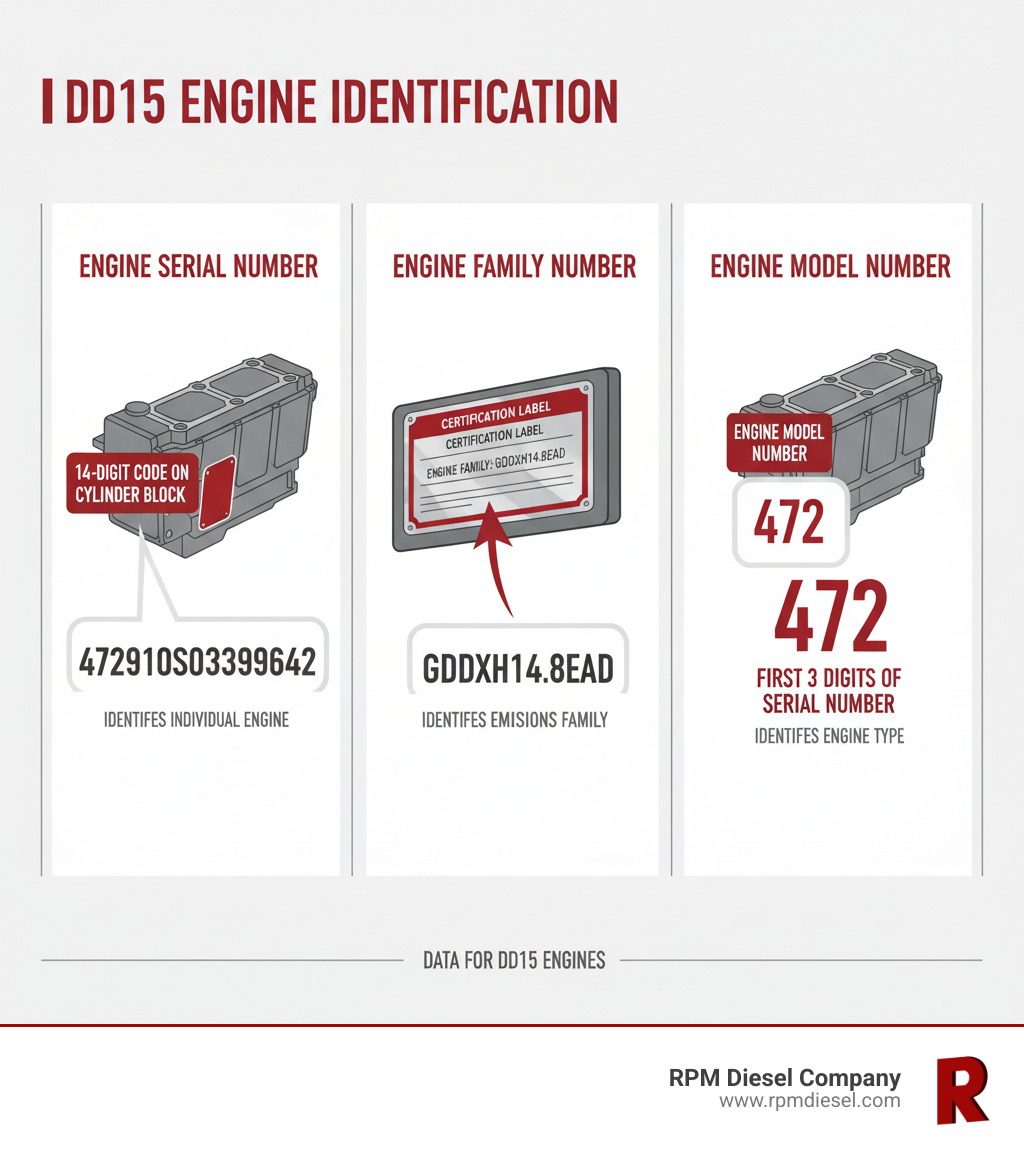
Let’s decode an example ESN: 472910S0399642. Each segment tells us something different about this particular engine.
The first three digits (472) are the engine model identifier. For Detroit Diesel engines, this is your quick reference to know exactly which engine you’re looking at. The code 472 specifically means you have a DD15 engine, while 471 would indicate a DD13. It’s that simple.
The next three digits (910) reveal the vehicle application and specific configuration. This segment is particularly interesting because it tells us about the engine’s original intended use and its specific generation. For marine engines, these digits might indicate which boat manufacturer originally specified the engine, and they also encode important details about the engine’s generationwhether it’s an EPA07, EPA10, GHG14, or GHG17 model, and whether it includes features like Asymmetric Turbo or Turbo Compound technology. A code like 901 might represent one application and generation, while 910 could indicate a different configuration entirely.
The single letter (S) identifies the assembly plant where your engine was built. When you see an ‘S’, that tells us your DD15 was assembled at Detroit’s main manufacturing facility. It’s a small detail that helps us understand your engine’s origins.
Finally, those last seven digits (0399642) make your engine truly one-of-a-kind. This is the sequential production number assigned to your specific engine as it rolled off the assembly line. No other DD15 from that plant has this exact number. This unique identifier is crucial for tracking your individual engine’s history, processing warranty claims, and accessing specific service records that apply only to your engine.
Detroit documents this ESN format in its official literature: DD Platform Operator Manual Model and Serial Number Designation.
At RPM Diesel, when you provide us with your complete 14-digit ESN, we can access detailed information that might not be immediately visible just by looking at the engine. This number connects us to manufacturing records and specifications that ensure we provide the most accurate service possible, whether you’re docked in Fort Lauderdale, cruising from Miami, or calling us from anywhere along Florida’s coast.
Common Problems and Solutions
Even with a clear roadmap, locating and using your dd15 engine family number can sometimes hit a snag. We understand the frustration—whether it’s a sun-faded label on your marine engine or simply not knowing which number to reference when ordering parts. At RPM Diesel, we’ve helped countless boat owners steer these exact challenges. Here’s how to overcome the most common obstacles you might face.
What If the Engine Family Number Sticker is Missing or Damaged?
Let’s be honest: marine environments are tough on everything, including those little certification labels. Between saltwater spray, engine heat, oil leaks, and the occasional wrench mishap during maintenance, that crucial sticker on your valve cover can fade, peel, or disappear entirely. If you’re staring at a blank rocker cover or a label that looks like it went through a battle with the elements, don’t panic. Your engine isn’t suddenly illegal, and there’s a straightforward path forward.
Your ESN is the Backup Key
14-digit Engine Serial Number we talked about earlier? The one permanently etched into your engine block? This is where it becomes your lifeline. Because this number is stamped directly into the metal, it’s virtually indestructible and contains all the information needed to retrieve your dd15 engine family number.
Here’s what to do: First, locate your ESN on the left-front side of the cylinder block. Write it down carefully—all fourteen digits matter. Then, reach out to an authorized Detroit Diesel service center like RPM Diesel. With your ESN in hand, we can access Detroit Diesel’s manufacturer database to pull up your engine’s complete birth certificate, including its original build specifications, emissions certification data, and yes, that elusive engine family number.
While some owners have reported that getting a physical replacement sticker can take several weeks through certain channels, the good news is that having the actual number is what matters most for parts ordering and service work. We can provide you with the correct dd15 engine family number immediately for your records. If you absolutely need a physical replacement label for regulatory inspections or documentation purposes, we can guide you through that process as well.
This is exactly why working with an authorized service provider matters. We have direct access to the manufacturer’s systems, so there’s no guesswork or waiting around for answers. Whether you’re docked in Fort Lauderdale, cruising near Miami, or anywhere else along Florida’s coast, we can quickly retrieve this critical information and get you back on the water.
Common Misconceptions
The confusion between different engine identification numbers is probably the most common issue we see. It’s completely understandable—there are several different codes associated with your DD15 marine engine, and they all serve different purposes. But mixing them up can lead to ordering wrong parts, delays in service, or unnecessary frustration.
Understanding the Three Key Numbers
Think of your engine’s identification system like a person’s identity. The model number (DD15) is like saying someone is “a doctor”—it’s a general category. The Engine Serial Number is like a social security number—it identifies one specific individual. The dd15 engine family number is like a professional certification—it groups similar professionals with the same qualifications and standards.
The Engine Model Number simply tells us you have a DD15. That’s helpful for general conversation, but it’s far too broad when you need specific parts or service. The 14-digit Engine Serial Number uniquely identifies your exact engine—where it was built, when, and its original configuration. This number is perfect for tracking your individual engine’s service history and warranty information.
But the dd15 engine family number? That’s specifically about emissions certification and regulatory compliance. It groups engines that share identical emissions control systems and are certified to the same standards—whether that’s EPA10, GHG14, GHG17, or another designation. This is the number that ensures emissions-related components are perfectly matched to your engine’s certified configuration.
Why This Matters for Your Service
Here’s a real-world scenario we see regularly: A boat owner calls asking for a replacement turbocharger. They provide their engine model (“DD15”) and think that’s enough. But a DD15 from 2010 with EPA10 certification has a different turbo than a 2017 DD15 with GHG17 standards. Even the ESN alone might not tell the whole story about which emissions-specific components are correct.
When you’re ordering emissions-related parts—things like diesel particulate filters, SCR systems, or EGR components—the engine family number is critical. For other components, your ESN might be the key identifier. And sometimes we need both numbers to ensure absolute accuracy.
Our team in Florida has years of experience navigating these distinctions. We know exactly which number to ask for depending on what you need, and we can quickly guide you through providing the right information. That’s part of what makes working with an authorized Detroit Diesel service provider like RPM Diesel so valuable—we speak the language fluently, so you don’t have to become an expert in engine identification codes.
Conclusion
Finding your dd15 engine family number doesn’t have to be complicated, but it’s absolutely vital for keeping your marine diesel engine running smoothly, legally, and efficiently. This small alphanumeric code—tucked away on that certification label on your rocker cover—is essentially your engine’s passport to compliance and proper service.
When you know your dd15 engine family number, you’re equipped to order the exact right parts, maintain emissions compliance (especially important when operating in Florida’s environmentally protected waters), and communicate clearly with service technicians about your engine’s specific configuration. It’s one of those small details that makes a massive difference in the long run.
And here’s the good news: even if that certification label has seen better days—faded by sun and salt spray, or accidentally damaged during previous maintenance—you’re not stuck. Your 14-digit Engine Serial Number (ESN), permanently etched into your engine block, serves as a reliable backup. With that ESN in hand, authorized service providers like our team at RPM Diesel can access Detroit Diesel’s comprehensive databases to retrieve your engine family number and all the critical specifications that come with it.
At RPM Diesel Company, we’ve helped countless marine diesel owners steer these technical details. Based in Florida with hubs in Fort Lauderdale, Miami, West Palm Beach, Boca Raton, and Delray Beach, we specialize in marine engine sales, service, and maintenance, offering on-site services worldwide. As an authorized Detroit Diesel and MTU service provider, we have direct access to factory databases, comprehensive parts inventory, and the expertise to handle everything from routine maintenance to tracking down those hard-to-find components.
Whether you’re dealing with a missing label, need help decoding your engine numbers, or simply want peace of mind that your DD15 marine engine is receiving the right service, we’re here to help. Our factory-authorized technicians understand the importance of precision when it comes to marine diesel engines—because out on the water, there’s no room for guesswork.
Ready to ensure your Detroit Diesel marine engine gets the expert care it deserves? Reach out to our team today.